                         The Olympic Peninsula
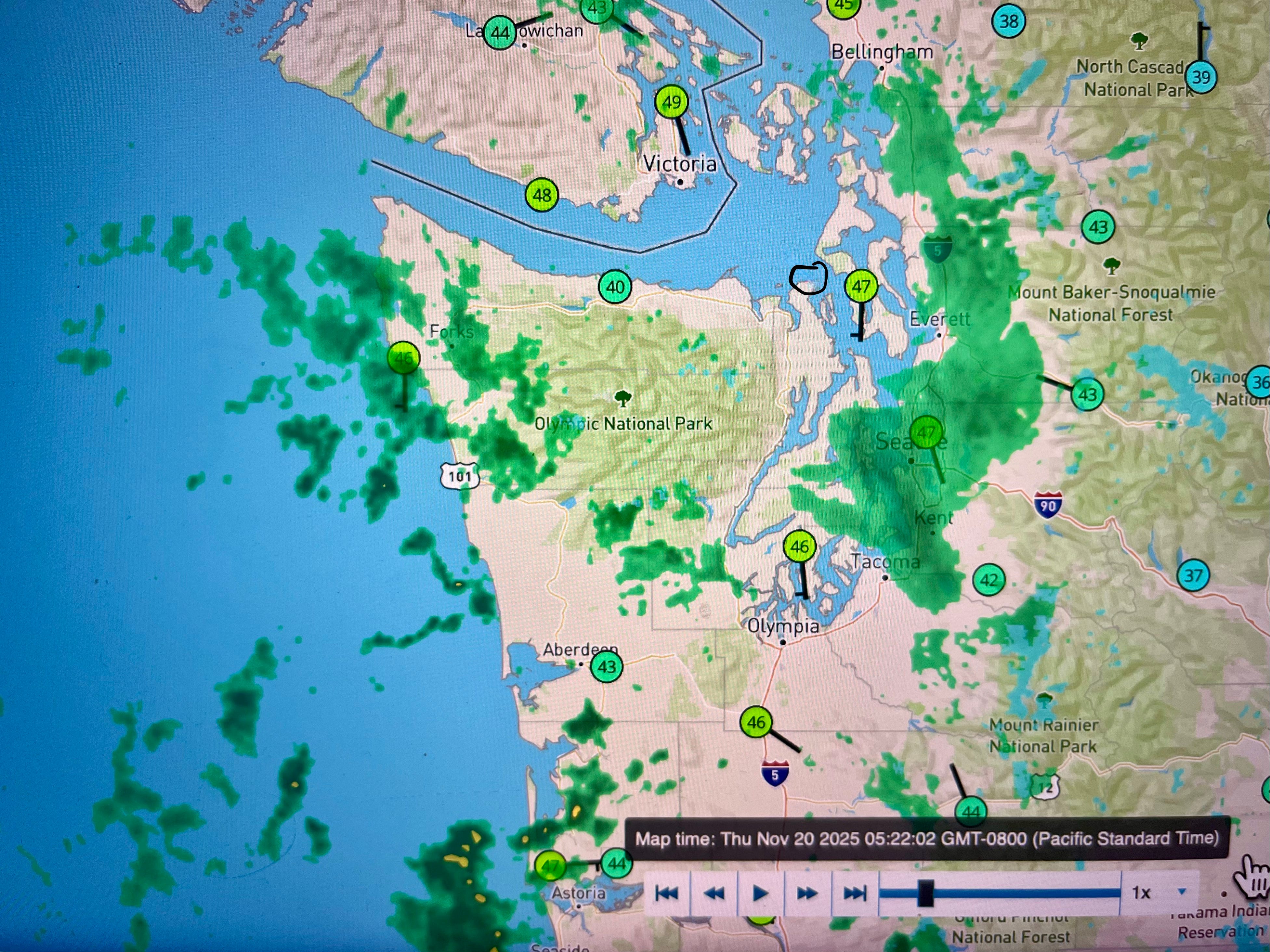
                        Radar Map, 0628, 11/20,25
               (Port Townsend is inside the Blue Circle)


It’s November, and the rains have started on the Olympic Peninsula. Out on the western coast, still rough, raw, and remote, over 100” of rain will fall before next summer. Up to 170” in some places. That’s why rainforests. That’s why the largest specimens of several types of trees grow  there. The world’s largest Douglas Fir, 13’ diameter; largest Sitka Spruce 17’ diameter; largest Western Red Cedar 19.5‘ diameter; largest Engleman spruce, a whopping 23’ diameter, all on the wet western slopes of the Quinault Rainforst within a few miles of the Pacific Ocean.

It would be more accurate to say the fall precipitation has started. We say rain because most people live at sea level, or near it, and rain is what we experience at sea level. Up high, it’s snow. For example, Mt. Olympus, the highest mountain in the Olympics at 7973’ gets between 50’ - 70’ of snow, but that’s not enough to keep the Blue Glacier, and all the other glaciers in the Olympics, from shrinking fast.

170,000,000 cubic miles of water fill the Pacific basin, half of all the oceanic water on earth. In winter the prevailing southwest winds pick up some of that water and carry it up the mountains, where it cools and turns to rain or snow or both. Sometimes all that moisture falls out of the sky before it gets to the other side of the mountains, which is where I live.

In Port Townsend many a day when the forecast calls for rain all around the region I look up into a thirty or forty mile diameter blue hole in the saturated clouds. This is the rainshadow, the lee of the weather wall created by the Olympic Mountains, and it’s a wonderful thing. Often when it’s raining everywhere else, Port Townsend and Sequim, Admiralty Inlet and southern parts of Whidbey Island, the San Juans, and Victoria, BC are under blue skies.

The Port Townsend rainshadow is small and local as far as these phenomena go. There’s no desert here. We still get 35” of rain in a year. From Point Hudson, at the north end of town, looking northeast to Mt. Baker, sweeping east and southeast to Mt Rainier, the Northern Cascades make a dramatic barrier of rock and ice and block oceanic moisture from reaching eastern Washington where the arid Palouse only gets 8” of rain a year.


Thanks, Tod. I’m endlessly fascinated by our climate and environment here.
How I'd love to see those forests! I like rainy places, which is just as well, since I live in one.